
This guide is for temporary freeze protection only.
It is intended for situations where freezing temperatures are forecasted and a professional sprinkler blowout has not yet been completed.
These steps help reduce the risk of freeze damage until a full sprinkler blowout can be scheduled later in the season.
Already Scheduled for Express Blowout?
Do NOT follow the steps below.
Use our Express Blowout checklist instead. Following the wrong steps can prevent us from properly clearing your sprinkler system.
Step 1: Shut Off the Water to the Sprinkler System
Locate the sprinkler shut-off valve inside your home (commonly in a basement, crawl space, or utility area) and turn the water completely off.
After shutting off the water, briefly run a sprinkler zone to confirm there is no remaining water pressure in the system.

Step 2: Open the Backflow Device (Critical Step)
This is the most commonly missed step.
Simply shutting off the water will not allow the system to drain. The backflow device must be opened correctly to allow air into the system.
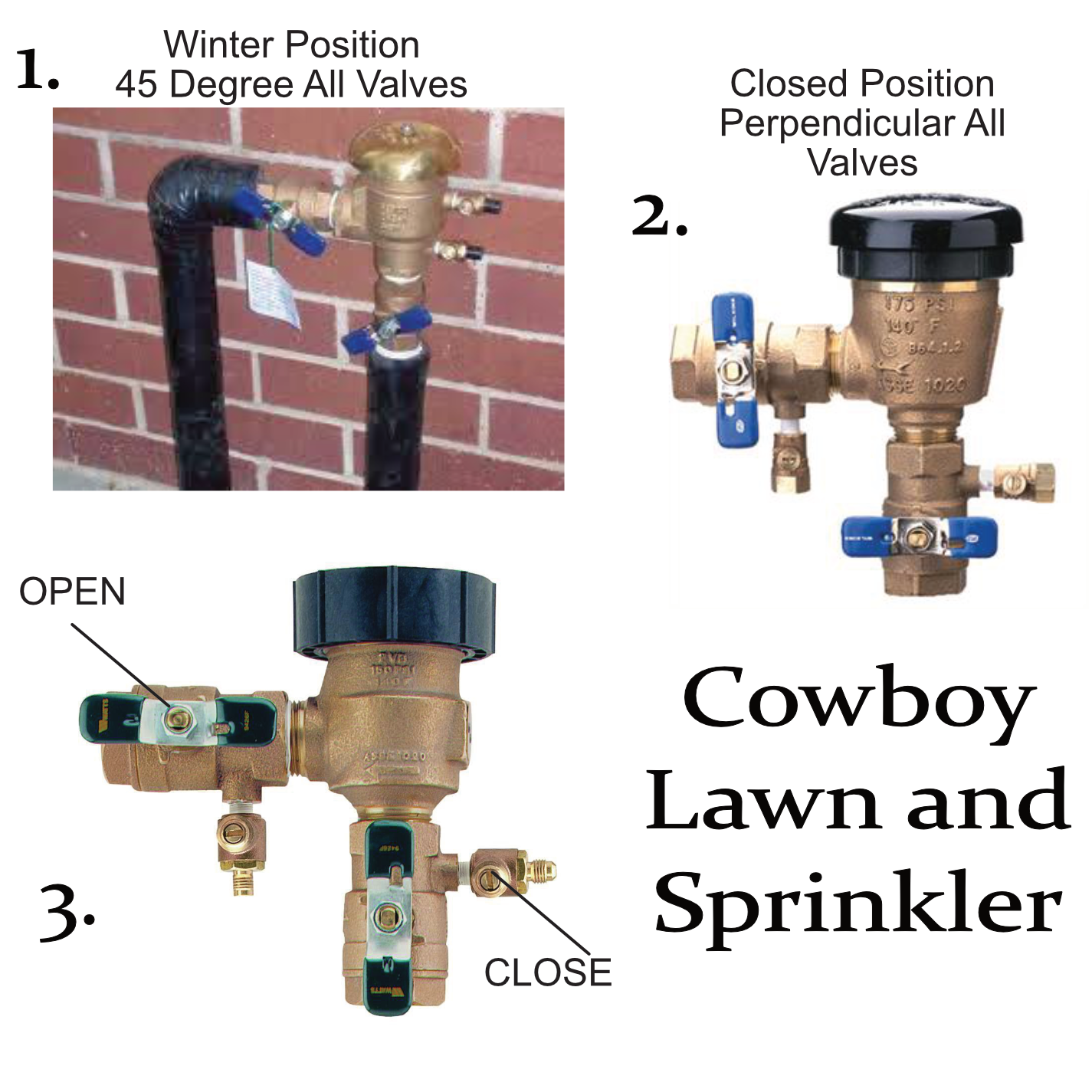
Set all isolation valves on the backflow device to a 45-degree angle, including:
- The inlet isolation valve
- The outlet isolation valve
- Any test-cock valves on the backflow assembly
Placing the valves at a 45-degree angle allows air to enter the system, breaking the vacuum pressure and allowing water to drain from both interior and exterior piping. If water is not draining, this is almost always the reason. In the below image label #1 is showing the correct setting for all 4 valves on the backflow device to allow proper draining. Label #3 is showing the setting the backflow device is typically in when the system is active. Label #2 is used if the water to the system is still on but you want to stop water flow from the backflow device.
Step 3: Open Drains
Return to the valve you used to shut off water to the sprinkler system. Most shutoff valves include a small drain port, often covered by a brass cap. Some systems may also have a drain spigot located next to the valve or inline on the pipe leading to the backflow device. Open the drain and allow any remaining water to empty into a bucket or container.
If water sprays out under pressure, the water supply has not been fully shut off or the incorrect valve was used. Close the drain immediately and confirm the correct sprinkler shutoff valve is turned completely off before proceeding.
If your sprinkler system has in-ground valve boxes with manual drain valves, open them briefly to allow water to escape.
Important: Once water has drained, close the valve again.
Leaving drains open can cause problems later during professional blowout service. We may not always see or hear air escaping from an open drain, which can prevent the system from being properly cleared.
Step 4: Run Sprinkler Zones With the Water Turned OFF
With the water supply shut off, manually run each sprinkler zone for 15–30 seconds.
This helps release residual water trapped in zone lines.
This step does not replace a blowout, but it can help reduce pressure on the exterior lines and valves.
Step 5: Protect All Exposed Piping
Any exposed piping, including the backflow device, should be protected from freezing temperatures.
We recommend a layered approach:
- Place a plastic bag directly over the metal or plastic piping
- Add an insulating layer (towel, blanket, or pipe insulation)
- Cover the insulation with another plastic bag to protect it from moisture
Purpose-built insulated covers designed for backflow devices and exterior piping are also a great option.
What NOT to Do
- Do not forget to close any valves or drains you opened
- Do not rely on insulation alone without draining water
- Do not assume the system is protected just because the water is shut off
- Do not repressurize the system after draining
Simply covering pipes and “hoping for the best” is one of the most common causes of freeze damage.
Important Reminder
This is a temporary freeze-protection measure only.
Your sprinkler system is not fully winterized using these steps.
A professional sprinkler blowout is still required to properly protect your system for the remainder of the winter. These steps are meant to reduce risk and buy time until full winterization can be completed.