
Hot weather, drought conditions, and watering restrictions can take a noticeable toll on lawns. Brown or thinning areas do not always mean the grass is dead, however. Depending on the level of stress, better use of your two permitted watering days may be enough to maintain the lawn, encourage recovery, or prevent additional damage.
Most of our customers are currently limited to watering two days per week, with watering also restricted to certain times of day. One important detail that is often overlooked is that these restrictions generally limit the days and allowable watering windows, not the total amount of time you may water within those permitted periods.
That means you may be able to get better results by dividing your watering into multiple cycles during the allowed watering windows rather than trying to provide all of the lawn’s water in one continuous run.
Why Use Multiple Watering Cycles?
Running a sprinkler zone for a long period does not necessarily mean all of that water is reaching the roots.
Once the soil can no longer absorb water as quickly as the sprinklers are applying it, water may begin running down sidewalks, driveways, slopes, or into the street. At that point, additional sprinkler time may simply be wasting water.
Using separate watering cycles gives the first application time to soak into the soil before more water is applied. This can be particularly helpful on slopes, compacted areas, and heavier soils where water is absorbed more slowly.
Our General Two-Day Watering Recommendation
Every lawn and sprinkler system is different, but the following is a good starting point for many established lawns.
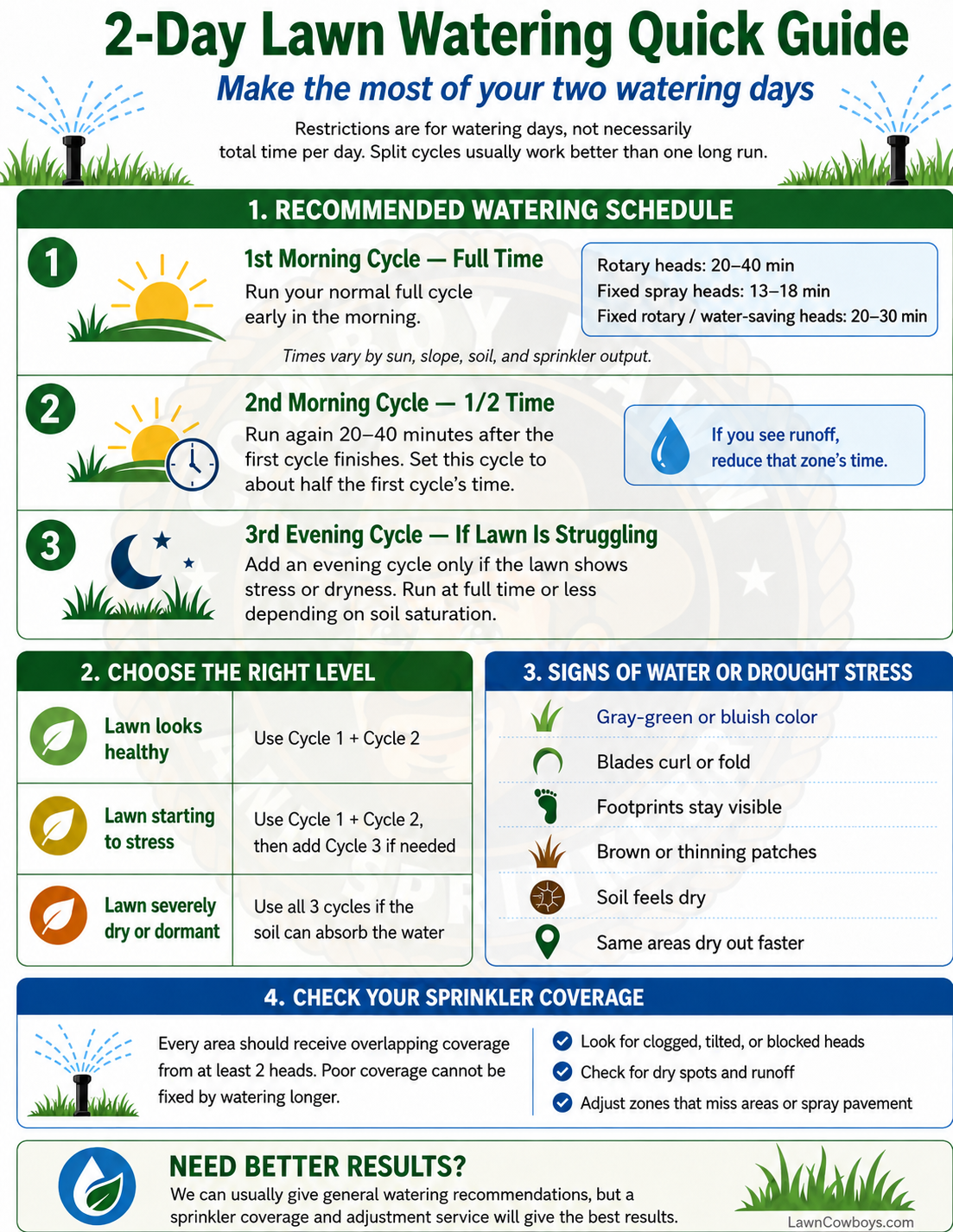
First Morning Cycle — Full Watering Time
Your first morning cycle should generally run for the full normal watering time.
As a starting point:
- Rotary heads: approximately 20–40 minutes per zone
- Fixed spray heads: approximately 13–18 minutes per zone
- Fixed rotary or water-saving heads: approximately 20–30 minutes per zone
These are general ranges, not exact settings. The appropriate amount of time can vary considerably depending on sun exposure, sprinkler output, soil type, slope, lawn condition, temperature, and other property-specific conditions.
A sunny south-facing area with sandy soil may require a very different schedule than a shaded lawn growing in heavier clay soil.
Second Morning Cycle — Allow the Water to Soak In
After the first cycle is complete, allow approximately 20–40 minutes for the water to soak into the soil before beginning the second cycle.
The second cycle can generally be set for about half of the first cycle’s watering time.
For example, if a rotary zone runs for 30 minutes during the first cycle, the second cycle might run for approximately 15 minutes.
Watch the lawn and surrounding surfaces during watering. If you see water running onto sidewalks, driveways, or streets, decrease the runtime for that particular zone. The goal is to get the water into the soil rather than allowing it to run off the property.
Third Cycle — For Lawns That Are Currently Struggling
If your lawn is maintaining good color and showing no signs of drought stress, two morning cycles may be sufficient.
If the lawn is already showing significant stress or dryness, consider adding a third cycle during the evening on your permitted watering days.
This additional cycle may be run at the full normal runtime or at a reduced runtime depending on how much moisture remains in the soil from the morning watering.
The goal is not simply to run the sprinklers longer. Check the soil and lawn condition and apply only as much additional water as the soil can absorb.
Choose the Approach That Matches Your Lawn
Not every lawn needs the same level of watering.
Lawn Is Healthy and Maintaining Color
Continue your normal two-day watering schedule. A full morning cycle followed by a shorter second cycle may help you use those watering days more efficiently.
There is usually no reason to add additional watering simply because more watering time is available.
Lawn Is Beginning to Show Stress
Increase your attention to coverage and soil moisture first.
Use the full first morning cycle and the shorter second cycle. If the lawn continues to dry excessively between watering days, consider adding the evening cycle.
Lawn Is Severely Dry or Dormant
A struggling lawn may benefit from all three cycles on the permitted watering days, provided the soil is absorbing the water without excessive runoff.
Keep in mind that severely drought-stressed turf may take time to respond. Some brown grass may be dormant and capable of recovering, while areas that have actually died will eventually require seeding or other lawn repair.
Lawn Has Only a Few Dry or Brown Areas
Before increasing watering across the entire property, check the sprinkler coverage in those specific areas.
Localized dry spots frequently indicate a coverage problem rather than a lawn that needs substantially more water everywhere.
Signs Your Lawn May Be Water-Stressed
Watch for changes in the lawn rather than relying only on the sprinkler timer.
Common signs of drought or water stress include:
- Grass developing a dull, gray-green, or bluish appearance
- Grass blades beginning to curl or fold
- Footprints remaining visible after walking across the lawn
- Areas that do not spring back quickly after being walked on
- Increasing brown or straw-colored patches
- Soil that is noticeably dry beneath the turf
- Specific areas consistently drying faster than the surrounding lawn
If the same areas repeatedly show stress while the rest of the lawn looks healthy, sprinkler coverage should be one of the first things you investigate.
More Water Cannot Fix Poor Sprinkler Coverage
One of the most common mistakes is increasing the watering time when the actual problem is inadequate sprinkler coverage.
For consistent results, every part of the lawn should ideally receive overlapping coverage from at least two sprinkler heads. This is often called head-to-head coverage.
A sprinkler head should not simply throw water halfway across an area and rely on that single spray pattern to provide even coverage. One head should generally be reaching toward the next head so the patterns overlap.
If one section of the lawn receives water from only one sprinkler—or barely receives water at all—it may remain dry regardless of how long the rest of the system runs.
Check for:
- Heads that are tilted or sinking
- Grass growing over or blocking sprinkler heads
- Heads that are no longer rotating properly
- Clogged or damaged nozzles
- Sprinklers spraying sidewalks instead of the lawn
- Areas that are outside the effective spray pattern
- Zones with noticeably different pressure or output
Correcting a coverage problem is usually more effective than continually adding watering time to the entire lawn.
We Can Help With Your Watering Schedule
As part of your lawn treatment service, we can usually provide general recommendations for adjusting your watering schedule based on what we observe during our visits.
However, sprinkler systems and individual properties can vary considerably. If you want more precise recommendations, we recommend scheduling a sprinkler coverage and adjustment service.
During that service, we can evaluate how the system is actually watering the lawn, identify poor coverage or unnecessary runoff, and make adjustments to help you get better results from the two watering days available to you.
The goal is not simply to use more water. It is to make the water you are permitted to use reach the areas that need it, soak into the soil, and support the lawn as efficiently as possible.